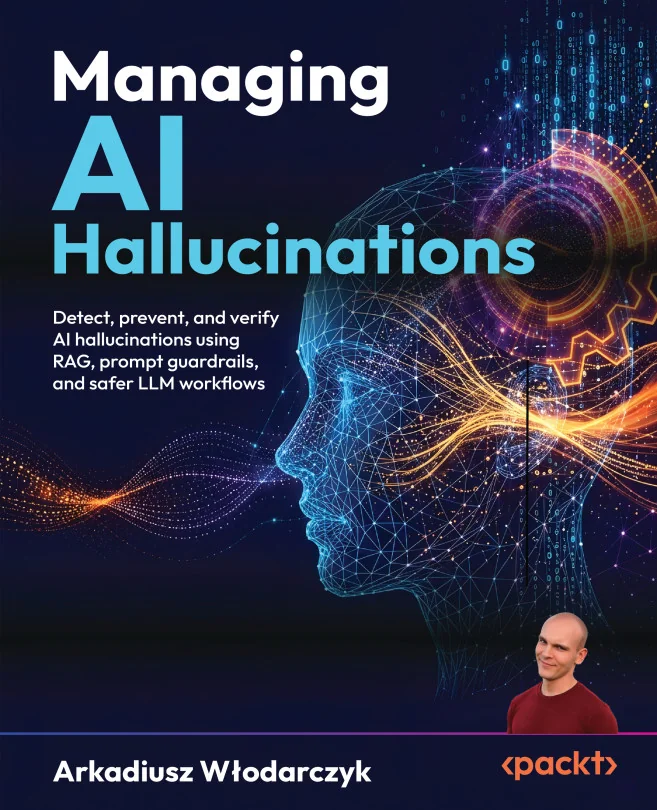
Managing AI Hallucinations
Detect, prevent, and verify AI hallucinations using RAG, prompt guardrails, and safer LLM workflows
Created by Arkadiusz Włodarczyk
Learn how to spot, prevent, and verify hallucinations in AI-generated content. Explore practical techniques like prompt guardrails, retrieval-augmented generation, and monitoring tools to make large language models more trustworthy for code, research, and decision-making.
Packt | Sep 2026 | 98 min
What You Will Learn
You will start by understanding why language models hallucinate and how to recognize unreliable outputs. Step by step, you'll apply prompt controls, source grounding, and fact-checking techniques using real code examples. By the end, you'll build monitoring workflows that help catch and address issues before they impact users.
Key Features
- Spot fabricated facts, weak citations, and unsafe outputs in LLM responses
- Use prompt guardrails, RAG, and model cross-checking to boost reliability
- Monitor and validate AI outputs for safer, more responsible deployment
Target Audience
Designed for data scientists, AI engineers, developers, and technical leads who work with large language models in production. If you're responsible for validating AI outputs, reducing risk, or communicating AI limitations, you'll find actionable methods here. Basic familiarity with LLM tools and APIs is helpful, but you don't need advanced programming skills.